Wind energy is one of the key renewable energy sources in the 21st century. Faced with growing electricity demand, global warming, and the need to reduce greenhouse gas emissions, harnessing wind energy is becoming not only beneficial but essential. Modern societies require energy solutions that are not only efficient but also environmentally friendly, and wind energy meets both criteria. 
Human history shows that wind has always played a vital role in everyday life. Even in ancient times, sails on ships enabled the transport of goods and people over long distances. In the Middle Ages, windmills in Europe and Asia ground grain, enabling the development of agriculture and local communities. However, it was not until the 20th century that industrial use of wind became possible, allowing the kinetic energy of air to be converted into electricity.

Wind energy is a renewable energy source, similar to solar energy, hydropower, and biomass. Its key characteristics are its inexhaustibility within a human lifetime and its lack of carbon dioxide and other harmful greenhouse gas emissions. In the era of global climate change, the development of wind energy is becoming not only a component of environmental protection strategies but also a key factor in national energy security.

Contemporary wind farms provide electricity for millions of households and industries. Furthermore, investments in wind energy stimulate local economic development, creating jobs in the technology, construction, and service sectors. Wind energy is therefore not only an alternative to fossil fuels, but also a foundation for sustainable development and energy transformation.

History of Wind Energy
Antiquity

The first applications of wind energy date back to ancient times. Egyptians and Phoenicians used wind to power sails on boats and ships. This enabled the transportation of goods and people, and the development of maritime trade. The use of sails allowed for covering greater distances in shorter times, which was crucial for the development of the economies of ancient states. The first windmills were built in Europe and Asia during the Middle Ages. These structures allowed for grinding grain and pumping water. In the Netherlands, windmills were used to drain wetlands, allowing for the expansion of agricultural land. During this period, wind energy was the primary source of mechanical work, largely replacing human and animal power.
19th and 20th Centuries
The first wind turbines were built in the 19th century. In 1887, German inventor Poul la Cour constructed a wind turbine to produce electricity, which powered a research laboratory. At the same time, small wind turbines used to pump water on farms appeared in the United States.
In the mid-20th century, experiments began with more powerful wind turbines capable of powering entire communities. In the 1970s and 1980s, as a result of the oil crisis, many countries began investing in wind energy as an alternative to fossil fuels. This led to the development of the first large-scale wind farms in Europe and the United States.
The Principle of Wind Turbines
Wind energy is generated by moving air masses, which create aerodynamic forces acting on the turbine blades. The turbine rotor, consisting of three long, aerodynamic blades, rotates under the influence of the wind. The rotor's rotational motion is transferred to the turbine's main shaft and then, through a gearbox, to an electric generator, which converts mechanical energy into electrical energy. 
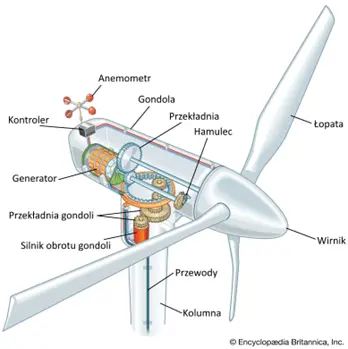
A wind turbine is a device that converts the kinetic energy of the wind into electrical energy. Its structure consists of several key components:

1. Rotor

This is the part that directly "catches" the wind. It consists of:

Blades (usually 2-3) – they have an aerodynamic shape similar to airplane wings, allowing them to rotate in response to the wind;

Hub – the central element to which the blades are attached.

2. Nacelle

The housing located at the top of the tower, containing the most important mechanisms:

Main shaft – transmits rotational motion from the rotor;
Gearbox – increases rotational speed (although some turbines do not have one);
Generator – converts mechanical energy into electrical energy;
Brake – stops the turbine when necessary (e.g., in the event of excessive wind);
Cooling and control systems. 3. Tower

A tall structure (often 80–150 m) that:

holds the turbine at the appropriate height, where the wind is stronger and more stable,
contains ladders or service elevators, and wiring.

4. Foundation

The base of the entire structure:

provides stability,
usually made of concrete and anchored to the ground.

5. Yaw System

Allows the nacelle to rotate so that the rotor is always pointed into the wind.

6. Pitch Control

changes the blade pitch,
allowing control of the turbine's rotational speed and power.

How it works in a nutshell:

Wind sets the blades in motion → the rotor turns the shaft → the generator produces electricity → the energy is fed into the electrical grid.

If you'd like, I can also draw a simple diagram or explain the operation step by step in more detail. The performance of wind turbines depends on many technical, environmental, and economic factors. The most important of these are: 
Wind Conditions

Wind speed is a key factor in turbine efficiency. In areas with average wind speeds of 5–6 m/s, turbines generate relatively little energy, while in regions with speeds of 7–10 m/s, energy production is significantly higher. Offshore wind farms typically have an advantage because the wind is stronger and more stable over the sea.

Mast Height and Blade Length

Higher masts allow for the use of stronger winds. In modern turbines, blades can be over 100 meters long, significantly increasing the amount of energy captured. Blade length and shape have a direct impact on the aerodynamics and efficiency of the turbines.

Energy Storage Systems

Wind energy is variable, so energy storage is essential. Lithium-ion batteries, pumped-storage hydropower plants, and hybrid systems allow for the use of surplus energy during periods of low wind.

Grid Integration

Turbine efficiency also depends on the ability to transmit energy to the grid. Intelligent grid management systems allow for dynamic balancing of wind energy production with other sources. Wind Conditions
Wind speed is a key factor in turbine efficiency. In areas with average wind speeds of 5–6 m/s, turbines generate relatively little energy, while in regions with speeds of 7–10 m/s, energy production is significantly higher. Offshore wind farms typically have an advantage because the wind is stronger and more stable over the sea.
Mast Height and Blade Length
Higher masts allow for the use of stronger winds. In modern turbines, blades can be over 100 meters long, significantly increasing the amount of energy captured. Blade length and shape have a direct impact on the aerodynamics and efficiency of the turbines.
Energy Storage Systems
Wind energy is variable, so energy storage is essential. Lithium-ion batteries, pumped-storage hydropower plants, and hybrid systems allow for the use of surplus energy during periods of low wind.
Grid Integration
Turbine efficiency also depends on the ability to transmit energy to the grid. Intelligent grid management systems allow for dynamic balancing of wind energy production with other sources. 
Wind Farm in the Pomeranian Voivodeship

One of the largest wind farms in Poland is the one in the Słupsk commune. The farm consists of several dozen turbines, each with a capacity of approximately 2-3 MW, generating energy for tens of thousands of households. The turbines are located in agricultural areas and coastal dunes, where the wind is strongest.

Wind Farm in the West Pomeranian Voivodeship

Many wind farms operate in the West Pomeranian Voivodeship, including those near Koszalin and Kołobrzeg. The turbines have a capacity of 2 to 3 MW each, and the region's total capacity exceeds 1 GW. Wind farms contribute not only to energy production but also to local economic development, creating jobs in turbine maintenance and infrastructure.

Statistics and Performance in Poland

The total installed capacity of wind turbines in Poland exceeds 6 GW, providing power to millions of households. The share of wind energy in the national energy mix exceeds 10%, and with offshore development plans, it could rise to 20–25% within the next two decades.

Polish wind farms are increasingly using modern turbines with long blades, intelligent control systems, and performance monitoring. Combined with the development of the power grid and energy storage, this maximizes energy production efficiency Despite its many advantages, wind energy also has certain limitations that must be considered when planning investments.
Wind Variability
The primary limitation is the variability of wind conditions. Turbines produce energy only when the wind is blowing at the appropriate speed. During periods of calm, energy storage or integration with other energy sources, such as gas or solar, is necessary.
Noise and Impact on the Landscape
Wind turbines generate mechanical and aerodynamic noise, which can be a nuisance to nearby residents. Furthermore, wind farms impact the landscape, which sometimes generates public opposition, especially in regions with tourist or natural values.
Threat to Birds and Bats
Turbine blades can pose a threat to birds and bats, especially in migratory areas. Modern technologies attempt to minimize collisions, for example, through intelligent systems that stop turbines during critical periods, but this issue still requires monitoring and ecological research. 
High Investment Costs

Constructing large wind farms, especially offshore, involves high initial costs. Installing turbines, offshore foundations, cable connections, and port infrastructure requires significant financial outlays. However, falling technology costs and increasing turbine efficiency are making investments increasingly profitable in the long term. 
Wind energy is currently facing dynamic technological development and expansion into new areas.

Offshore Turbines

Offshore wind farms utilize stable and strong winds over the sea, allowing for higher efficiency than onshore wind farms. Projects such as Hornsea One in the UK and German offshore wind farms demonstrate that marine energy has the potential to become a major energy source in European countries.

Integration with Other Renewable Energy Sources

Combining wind farms with solar power plants, energy storage systems, and smart grids allows for stable energy production year-round. Hybrid systems increase reliability and enable fuller utilization of renewable energy potential.

Modern Turbine Technologies

The development of turbines with higher power, blades over 100 meters long, and intelligent control systems maximizes energy production. Additionally, research is underway to reduce noise and impact on wildlife, making wind farms more environmentally friendly.

Investments in Poland and Around the World
Poland plans to develop offshore wind farms in the Baltic Sea, which could increase installed capacity by several GW over the next decade. Globally, investment in wind energy is growing every year, especially in Asia, Europe, and North America. This trend indicates that wind energy will play an increasingly important role in the global energy mix.

Conclusion

Wind energy is one of the foundations of the global energy transition. By generating electricity without emitting harmful gases, it increases national energy security and supports the development of a sustainable economy. Wind farms, both onshore and offshore, demonstrate that it is possible to generate significant amounts of energy ecologically and efficiently.

Despite certain limitations, such as wind variability, noise, and impact on landscape and wildlife, modern technologies can minimize these problems. Intelligent control systems, energy storage, integration with other renewable sources, and the development of offshore wind farms are making wind energy a reliable and cost-effective energy source.

The development of wind energy brings not only ecological but also economic and social benefits. It creates jobs, supports local communities, develops new technologies, and reduces dependence on fossil fuel imports. In the future, wind energy will play a key role in ensuring energy security, the stability of power systems, and environmental protection.
.
Wind energy is not only an alternative to traditional energy sources but also the foundation of a future, sustainable energy economy. Its role in the global energy mix will steadily grow, and technological development, investment, and innovation will make wind energy a primary source of clean energy for millions of people worldwide.