The history of solar energy officially began in 1839 with a 19-year-old French physicist named Edmond Becquerel. While experimenting in his father’s laboratory, Becquerel constructed a rudimentary electrolytic cell made of two metal electrodes placed in an electrically conductive solution. He observed that when he exposed the setup to light, the generation of electricity increased. He had discovered the photovoltaic effect—the fundamental physical process through which light generates voltage and electric current in a material.
However, Becquerel’s discovery remained largely an academic curiosity for decades. The exact mechanism of why this happened was not understood, as the existence of the electron had not yet been discovered.


1.3 Albert Einstein and the Photoelectric Effect (1905)
The theoretical foundation of how solar cells actually work was laid by Albert Einstein in 1905. In his groundbreaking paper on the photoelectric effect, Einstein proposed that light was not merely a continuous wave, but was composed of discrete packets of energy, which we now call photons. He theorized that when photons of sufficient energy strike a material, they can knock electrons loose from their atoms. This brilliant theoretical work explained the anomalies that classical physics could not, and it eventually earned Einstein the Nobel Prize in Physics in 1921. His work provided the scientific blueprint necessary to understand and improve photovoltaic materials.
The modern era of solar power truly began at Bell Laboratories in the United States in 1954. Three scientists—Daryl Chapin, Calvin Fuller, and Gerald Pearson—were experimenting with silicon, a highly abundant element found in sand. They discovered that by introducing specific impurities into silicon (a process called “doping”), they could create a material that was highly sensitive to light.
On April 25, 1954, Bell Labs publicly demonstrated the first practical silicon solar cell. It had an efficiency of about 6%—a massive leap from the selenium cells of the past. For the first time, a solar device could generate enough power to run everyday electrical equipment. The New York Times touted it as the beginning of a new era, “leading to the realization of one of mankind’s most cherished dreams—the harnessing of the almost limitless energy of the sun.”
Fun Fact NR Uno
To prawda, że dla paneli fotowoltaicznych najobfitszym źródłem energii jest Słońce i jego promienie – to one, pochłaniane, przekształcają się nią. Jednak aby panele działały, światło słoneczne wcale nie musi docierać do nich bezpośrednio. Panele fotowoltaiczne z łatwością przechwytują także różne odbicia, również w przypadku dni pochmurnych. Brak słońca na niebie przesłanianym przez chmury nie oznacza, że panele fotowoltaiczne nie pracują, a odbicia nie są wychwytywane i wykorzystywane do produkcji energii. Bo tak jest!

Despite the Bell Labs breakthrough, early silicon solar cells were prohibitively expensive, costing hundreds of dollars per watt of power generated. They were unfeasible for everyday terrestrial use. However, they found a perfect niche in the emerging aerospace industry.
When the Space Race began, engineers needed a reliable, long-lasting power source for satellites that could not be tethered to Earth or rely solely on heavy batteries. In 1958, the Vanguard I satellite was launched, becoming the first spacecraft to use solar panels. The solar cells powered the satellite’s radios for years, proving the incredible durability and reliability of the technology. Throughout the 1960s, solar technology was refined primarily for space exploration, which drove efficiency up and began to slowly bring costs down.
The global oil crisis of the 1970s served as a massive wake-up call for the industrialized world. The sudden shortage of fossil fuels and the resulting economic shock highlighted the vulnerability of relying entirely on imported oil. Governments around the world, particularly the United States and Japan, began pouring money into renewable energy research, including photovoltaics.
During this time, Dr. Elliot Berman, with financial backing from Exxon, designed a significantly cheaper solar cell by using lower-grade silicon and cheaper packaging materials. He brought the price down from $100 per watt to about $20 per watt. This price drop opened up new niche markets on Earth: powering remote offshore oil rigs, railroad crossings, and telecommunications relay towers in areas where running traditional power lines was impossible.
Chapter 3: Types of Photovoltaic Panels
Not all solar panels are created equal. Depending on the manufacturing process and the materials used, solar panels can have different efficiencies, aesthetics, lifespans, and price points. The market is primarily divided into three main generations of technology.
3.1 First Generation: Crystalline Silicon (c-Si)
These are the traditional panels that dominate over 90% of the global market today. They are highly reliable, long-lasting, and offer the best balance of efficiency and cost. They are divided into two main categories:
A. Monocrystalline Solar Panels (Mono-SI)
How they are made: Monocrystalline panels are made using the Czochralski process. A single “seed” crystal of silicon is dipped into a vat of pure, molten silicon. The seed is slowly pulled upwards and rotated. The molten silicon crystallizes around the seed, forming a massive, single, continuous cylindrical crystal of silicon called an ingot. This ingot is then sliced into ultra-thin wafers.
Characteristics: Because the cell is composed of a single, continuous crystal lattice, electrons have more room to move, resulting in a higher efficiency. They typically boast efficiency rates between 19% and 23%.
Appearance: They have a uniform, sleek black color, which makes them highly desirable for residential rooftops where aesthetics matter.
Pros & Cons: They are the most efficient and space-efficient panels, and they perform slightly better in high heat and low-light conditions. However, the manufacturing process wastes a lot of silicon (as the cylindrical ingots are trimmed into squares), making them the most expensive type of traditional panel.
B. Polycrystalline Solar Panels (Poly-SI)
How they are made: Instead of pulling a single crystal, the manufacturer melts multiple fragments of raw silicon together and pours the mixture into a square mold to cool. Once cooled, this block of multi-crystalline silicon is sliced into wafers.
Characteristics: Because the material consists of many smaller crystals melted together, there are “grain boundaries” between the crystals that impede the flow of electrons. As a result, their efficiency is lower, typically between 15% and 18%.
Appearance: They have a distinct, speckled blue, mosaic-like appearance due to the way light reflects off the different crystal fragments.
Pros & Cons: The manufacturing process is faster, simpler, and wastes almost no silicon, making them significantly cheaper to produce. However, their lower efficiency means you need more panels (and more roof space) to generate the same amount of power as a monocrystalline system.
3.2 Second Generation: Thin-Film Solar Panels
Thin-film panels are made by depositing one or more extremely thin layers of photovoltaic material onto a substrate like glass, plastic, or metal. These layers are mere nanometers to micrometers thick—hundreds of times thinner than traditional silicon wafers.
Materials Used: * Amorphous Silicon (a-Si): Non-crystalline silicon, often used in pocket calculators.
Cadmium Telluride (CdTe): The most common thin-film technology, highly cost-effective for large solar farms.
Copper Indium Gallium Selenide (CIGS): Offers the highest efficiency among thin films.
Characteristics: Thin-film panels have lower efficiencies (typically 10% to 15%), meaning they require vast amounts of space.
Pros & Cons: Their biggest advantage is that they can be flexible, lightweight, and incorporated into unconventional shapes. They also suffer less performance degradation in extreme heat compared to crystalline silicon. However, their low efficiency makes them unsuited for residential rooftops. They are mostly used in massive commercial installations or specialized applications (like flexible panels for RVs or boats).
3.3 Third Generation: Emerging and Advanced Technologies
The solar industry is constantly innovating to push past the theoretical efficiency limits of standard silicon.
Bifacial Solar Panels: These are crystalline silicon panels that capture sunlight on both their front and back sides. The back side uses a transparent backsheet or glass to absorb light that reflects off the ground or roof (the albedo effect). When installed on highly reflective surfaces (like white commercial roofs or snow), they can boost total energy output by 10% to 30%.

The transition away from fossil fuels to solar energy is driven by a combination of severe environmental imperatives, compelling economic advantages, and the desire for geopolitical stability.
The most critical reason for the deployment of photovoltaic panels is the mitigation of anthropogenic climate change.
Traditional electricity generation relies heavily on the combustion of coal, natural gas, and oil. This combustion releases massive quantities of carbon dioxide ($CO_2$), methane ($CH_4$), and nitrous oxide ($N_2O$) into the atmosphere. These greenhouse gases trap heat, leading to global warming, sea-level rise, extreme weather events, and ocean acidification. Furthermore, burning fossil fuels releases particulate matter, sulfur dioxide, and nitrogen oxides, which cause smog, acid rain, and severe respiratory illnesses in humans.
Solar panels, in stark contrast, produce zero direct emissions during their operational lifespan. Once installed, a solar panel silently generates clean energy without emitting a single gram of greenhouse gas. While there is a carbon footprint associated with mining the materials, manufacturing the panels, and transporting them, studies show that a modern solar panel “pays back” its manufacturing carbon debt within 1 to 3 years of operation. For the remaining 25+ years of its life, it produces absolutely carbon-free energy.
In the past, solar energy was heavily subsidized because it was more expensive than fossil fuels. Today, the paradigm has completely flipped. According to the International Energy Agency (IEA), solar power is now “the cheapest source of electricity in history” in most parts of the world.
For Homeowners: Installing solar panels essentially allows a homeowner to pre-pay for 25 years of electricity at a fixed, discounted rate. It protects consumers from the constant inflation of utility prices. Systems like Net Metering allow homeowners to send excess electricity generated during the sunny day back to the grid in exchange for credits, which they can use to draw power at night. Over the lifespan of a system, homeowners can save tens of thousands of dollars.
For the Economy: The solar industry is a massive job creator. Installing, maintaining, and manufacturing solar panels requires a vast, localized workforce. Because installation must happen on-site, these are jobs that cannot easily be outsourced.
Low Operating Costs: Unlike a coal or gas plant that requires a constant, expensive supply of mined fuel to operate, the fuel for a solar farm—sunlight—is entirely free. Furthermore, because PV panels have no moving parts, the maintenance and operating costs (O&M) are incredibly low, consisting mostly of occasional cleaning and inverter replacement.

Fossil fuels are geographically concentrated. A few nations control the vast majority of the world’s oil and gas reserves. This leads to profound geopolitical instability, wars, and economic shocks when supply chains are disrupted or embargoes are enacted.
Solar energy democratizes power generation. Every country on Earth receives sunlight. By investing in photovoltaics, nations can drastically reduce their reliance on imported foreign fuels, insulating their economies from global energy crises and enhancing their national security. On a micro-level, combining solar panels with home battery storage provides individual homeowners with security against grid blackouts and natural disasters.
Despite its massive advantages, solar energy is not a silver bullet and comes with inherent challenges that engineers and grid operators must solve.
Intermittency: The most obvious limitation is that solar panels only work when the sun is shining. They produce nothing at night, and their output drops significantly during heavy cloud cover or rain.
The “Duck Curve”: Because solar produces massive amounts of energy in the middle of the day, it can oversupply the electrical grid. Then, as the sun sets in the evening—exactly when people come home from work and turn on their lights, ovens, and TVs—solar production plummets, and grid demand spikes. This steep ramp-up requires fast-reacting (and often polluting) natural gas “peaker plants” to fire up instantly to prevent blackouts.
The Storage Imperative: To solve the intermittency and Duck Curve problems, solar must be paired with energy storage. Utility-scale lithium-ion battery banks, pumped hydro storage, and emerging long-duration storage technologies are required to save the excess daytime solar energy for use at night.
Land Use: Solar is a diffuse energy source. Generating the same amount of electricity as a compact nuclear power plant requires thousands of acres of solar panels. This can lead to conflicts over land use, particularly regarding agricultural land or sensitive wildlife habitats.


Understanding how a solar panel is made, and what happens to it when it dies, is crucial for assessing its true sustainability.
The journey begins with silicon dioxide (silica), commonly found in quartz sand. It is the second most abundant element in the Earth’s crust. The quartz is mined and placed into massive electric arc furnaces with carbon sources (like coal or wood chips). At extremely high temperatures, the carbon reacts with the oxygen in the quartz, leaving behind Metallurgical Grade Silicon (about 99% pure).
However, 99% is not pure enough for a solar cell. The silicon must undergo a highly energy-intensive chemical purification process (often the Siemens process) to become Polysilicon, which is 99.9999% pure.
As described in Chapter 3, this hyper-pure polysilicon is melted down and formed into massive cylindrical or square blocks called ingots. Using advanced wire saws laced with diamond dust, these ingots are sliced into ultra-thin wafers, no thicker than a human hair.
These fragile wafers are then processed into solar cells. They are chemically cleaned, textured (to reduce reflection), and subjected to the high-temperature phosphorus diffusion process to create the crucial P-N junction. Finally, an anti-reflective coating is applied, and the tiny silver electrical grid lines are printed onto the surface.
The individual cells are essentially useless on their own. Robotic assembly lines solder the cells together into strings. These strings are laid out on a sheet of glass, encapsulated in layers of EVA plastic, and sealed with a protective backsheet. The entire “sandwich” is heated in a vacuum laminator to melt the plastic and perfectly seal the cells. An aluminum frame is added, the junction box is attached, and the panel is flash-tested with a massive strobe light to determine its exact wattage output before being shipped to the consumer.
Once installed, a tier-1 solar panel is expected to last for decades. They are incredibly robust, designed to withstand hurricane-force winds, heavy snow, and golf-ball-sized hail. Over time, however, ultraviolet radiation and thermal cycling cause the materials to slowly degrade. The industry standard guarantees that a panel will produce at least 80% to 85% of its original power output after 25 years. In reality, many panels installed in the 1980s are still functioning perfectly today, albeit at slightly lower efficiencies.
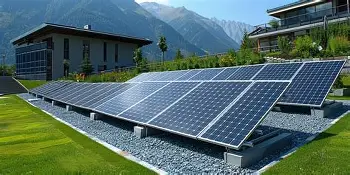
The versatility of photovoltaic technology means it can be deployed at almost any scale, from microwatts to gigawatts, and in virtually any environment on (or off) Earth.
This is the most visible application for everyday consumers. Homeowners install arrays of 10 to 30 panels on their roofs to offset their electricity bills. These systems are typically “Grid-Tied.” This means the home uses solar power when the sun is shining, but automatically pulls power from the city grid at night or when it’s cloudy. Conversely, if the home generates more solar power than it needs, the excess is pushed out into the grid, literally spinning the electric meter backwards (Net Metering). Increasingly, residential systems are being paired with home batteries (like the Tesla Powerwall) to provide backup power during outages.
Large flat rooftops of warehouses, factories, big-box retail stores, and shopping malls are ideal real estate for solar arrays. Corporations deploy solar not only to meet sustainability and ESG (Environmental, Social, and Governance) goals but also as a strict financial calculation to lock in low energy costs and increase profitability.
Fun Fact Nr DOS
Choć najczęściej spotyka się panele fotowoltaiczne na dachach domów, a przetwarzane energia wykorzystywana jest do zasilenia gospodarstw domowych, dobrze pamiętać, że nie jest to jedyna możliwość. Wykorzystanie energii słonecznej od dawna wykracza poza spektrum celów związanych z elektrycznością domową. Ciekawostką jest, że swoje zastosowanie panele odnajdują również w przypadku zasilania pojazdów. Od samochodów po pociągi, a teraz nawet… samoloty – coraz więcej osób podróżuje, korzystając wyłącznie z energii słonecznej, nawet o tym nie wiedząc!
Warto mieć na uwadze, jak szerokie może być zastosowanie energii słonecznej poza domami i biurowcami. Potencjał, jaki tkwi w niestandardowych instalacjach fotowoltaicznych, wciąż pozostaje niezmierzony. Jedno tylko jest pewne: to one zmieniają nasze codzienne życie na lepsze.

3.2 Second Generation: Thin-Film Solar Panels
Thin-film panels are made by depositing one or more extremely thin layers of photovoltaic material onto a substrate like glass, plastic, or metal. These layers are mere nanometers to micrometers thick—hundreds of times thinner than traditional silicon wafers.
Materials Used: * Amorphous Silicon (a-Si): Non-crystalline silicon, often used in pocket calculators.
Cadmium Telluride (CdTe): The most common thin-film technology, highly cost-effective for large solar farms.
Copper Indium Gallium Selenide (CIGS): Offers the highest efficiency among thin films.
Characteristics: Thin-film panels have lower efficiencies (typically 10% to 15%), meaning they require vast amounts of space.
Pros & Cons: Their biggest advantage is that they can be flexible, lightweight, and incorporated into unconventional shapes. They also suffer less performance degradation in extreme heat compared to crystalline silicon. However, their low efficiency makes them unsuited for residential rooftops. They are mostly used in massive commercial installations or specialized applications (like flexible panels for RVs or boats).
3.3 Third Generation: Emerging and Advanced Technologies
The solar industry is constantly innovating to push past the theoretical efficiency limits of standard silicon.
Bifacial Solar Panels: These are crystalline silicon panels that capture sunlight on both their front and back sides. The back side uses a transparent backsheet or glass to absorb light that reflects off the ground or roof (the albedo effect). When installed on highly reflective surfaces (like white commercial roofs or snow), they can boost total energy output by 10% to 30%.